
- Introduction
- The Science of Failure: Dust + Heat = Death
- What is a “Dust Proof” Projector?
- LCD vs. DLP: Which Handles Indian Dust Better?
- Buying Guide: Top Features for India
- Budget vs. Premium: What Do You Get?
- Visualizing the Difference
- Maintenance: How to Extend Lifespan (Even for Sealed Units)
- Frequently Asked Questions (FAQs)
Introduction
You’ve finally set up your dream home cinema. The popcorn is ready, the lights are dim, and you fire up your projector. But instead of a crisp movie scene, you see it: a brownish-yellow burn mark in the center of the screen, or worse, a cluster of black dots that look like dead pixels.
If this sounds familiar, you aren’t alone. In India, nearly 90% of budget projectors develop image quality issues within the first 6 to 8 months.
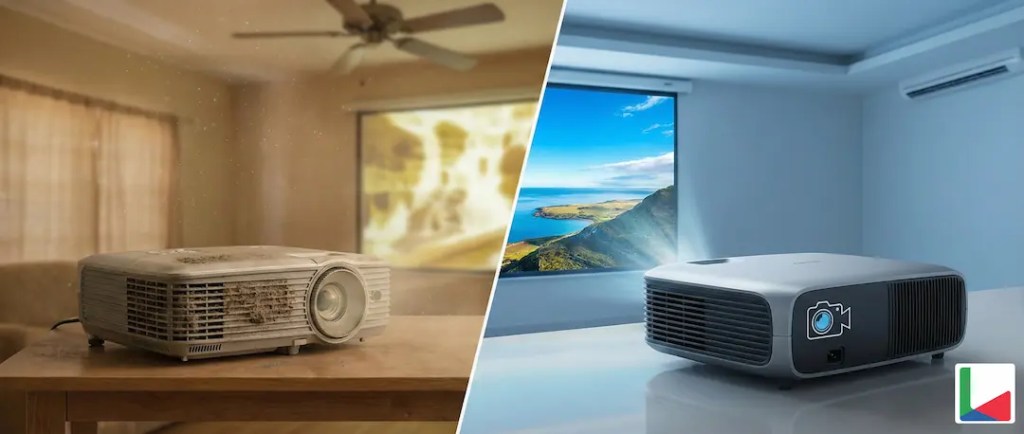
Why? It isn’t always bad manufacturing. It’s the environment. Most projectors sold globally are designed for air-conditioned, dust-free Western living rooms. Open engine projectors take in air from surrounding to cool their led light source without any filteration. When these “open-engine” designs meet the dusty, humid reality of Indian cities like the construction dust of Gurgaon or the humidity of Mumbai, they suffocate.
This guide isn’t just about why they fail; it’s about how to choose a dust proof projector in India that actually lasts, saving your money and your movie nights.
The Science of Failure: Dust + Heat = Death
To understand the solution, we must understand the failure mechanism. Projectors are essentially high-powered light cannons. They generate immense heat and require active cooling (fans) to survive.
The “Open Engine” Trap
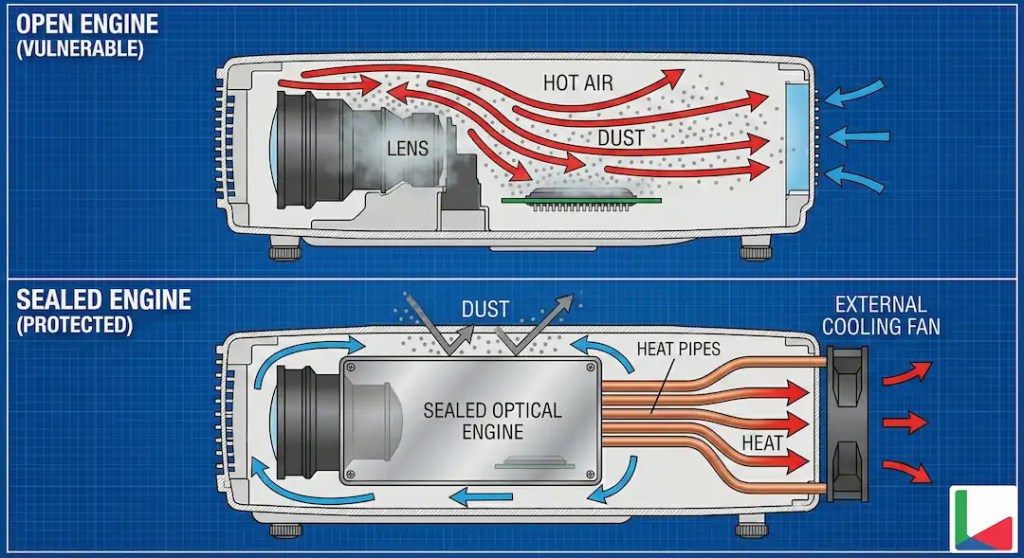
In a standard open-engine projector (common in budget LCD models), air is sucked in through a simple filter to cool the LCD panel and bulb.
- The Problem: Fine Indian dust (PM2.5) bypasses these cheap mesh filters.
- The Result: Dust settles on the LCD panel or the polarizer. As the light beam hits this dust, it heats up, literally burning the polarizer. This creates the infamous “yellow spot” or “brown burn” that cannot be fixed—only replaced.
The Humidity Factor
In India, it’s not just dry dust. High humidity acts as a binding agent, turning dust into a sticky layer of grime inside the machine that compressed air cans cannot dislodge.
What is a “Dust Proof” Projector?
Marketing jargon often confuses buyers. Here is the technical reality you need to know.
Sealed Optical Engines Explained
A Sealed Optical Engine is a design where the critical optical components (lens, light source, chips, and mirrors) are hermetically sealed in an airtight chamber.
- How it cools: The heat is transferred out via a heat sink or a radiator system that sits outside the sealed chamber.
- The Benefit: Air (and dust) never touches the lens or the chip.
IP Ratings: The Gold Standard
Don’t trust the label “Dust Proof” unless it has an IP rating.
- IP5X: Dust protected. Limited ingress permitted, but it will not interfere with operation.
- IP6X: Dust tight. No ingress of dust allowed.
Pro Tip: If a brand claims “Dust Proof” but doesn’t list an IP rating or explicitly state “Sealed Optical Engine,” it is likely just using a finer mesh filter. And that will fail sooner or later.
LCD vs. DLP: Which Handles Indian Dust Better?
The LCD Vulnerability
Traditional single-panel LCD projectors (the affordable ones) are most prone to “polarizer burn.” Once dust settles on the panel, the intense heat cooks it onto the glass.
The DLP Advantage
DLP (Digital Light Processing) projectors, used by brands like BenQ and Optoma, often use a sealed chip design. The DMD chip (the heart of a DLP) is less prone to burn-in than an LCD panel. However, the color wheel in non-sealed DLPs can still get clogged, leading to flickering colors or a whining noise.
Buying Guide: Top Features for India
When searching for a projector in 2024-2025, prioritize these specs over simple “brightness” numbers:
- Fully Sealed Optical Engine: This is non-negotiable for longevity. Look for projectors like E gate Duster 5x Pro
- Removable/Washable Dust Filter: Even sealed units need their outer vents cleaned. A removable filter makes this easy.
- High Thermal Threshold: Look for projectors with efficient copper heat pipes.
- Warranty on Optical Engine: Some brands offer a specific warranty against “black spots.”
Budget vs. Premium: What Do You Get?
The Sub-₹20k Segment (Wanbo, E-Gate, Vizony)
Brands like Wanbo and E-Gate have revolutionized this space by bringing sealed engines to budget models.
- Pros: Affordable, dust-proof designs are becoming standard.
- Cons: Lower brightness (ANSI lumens), plastic lenses (can warp with heat).
The Premium Segment (BenQ, Epson, Optoma)
- Pros: High brightness, glass lenses, IP5X/IP6X certification.
- Cons: Expensive (₹60k+), repairs are costly if out of warranty.
Visualizing the Difference
Image Concept 1: The “Black Spot” Nightmare


Image Concept 2: Open vs. Sealed Engine
Maintenance: How to Extend Lifespan (Even for Sealed Units)
Even a sealed projector can die if the outer vents block up, causing general overheating.
- The 2-Week Rule: Wipe the exterior vents with a microfiber cloth every two weeks.
- Ceiling Mount Warning: Heat rises. Ceiling-mounted projectors suck in the hottest air in the room. Ensure your ceiling fan doesn’t push dust directly into the projector’s intake.
- Cover It Up: When not in use, put a dust cover (or a simple cloth) over the projector. This simple step prevents 50% of dust accumulation.
Frequently Asked Questions (FAQs)
Q1: Can I fix the black spots on my projector myself? A: Usually, no. Black spots indicate the polarizer or LCD panel is permanently burned. Cleaning won’t remove them; the hardware needs replacement.
Q2: Is a “dust filter” the same as a “sealed engine”? A: No. A filter is just a mesh that catches large particles (like hair). A sealed engine is an airtight chamber that blocks microscopic dust (PM2.5) completely.
Q3: Which is the best dust proof projector brand in India? A: For budget users, Wanbo and E-Gate (specifically their sealed models) are popular. For premium users, BenQ offers IP5X certified laser projectors.
Q4: Do laser projectors need dust proofing? A: Yes, absolutely. While laser light sources last longer, dust can still block the optical path or overheat the laser diode, significantly reducing brightness.
Q5: How often should I clean my projector filter? A: In an average Indian home, clean the external filter every 100 hours of use (roughly once a month).
References
- BenQ India: “Harmful Effects of Dust on Laser Projectors” – Detailed analysis of how dust impacts internal components.
- Epson Technology: “Dustproof Measures for Projectors” – Insights into electrostatic filters and sealed blocks.

Leave a comment